
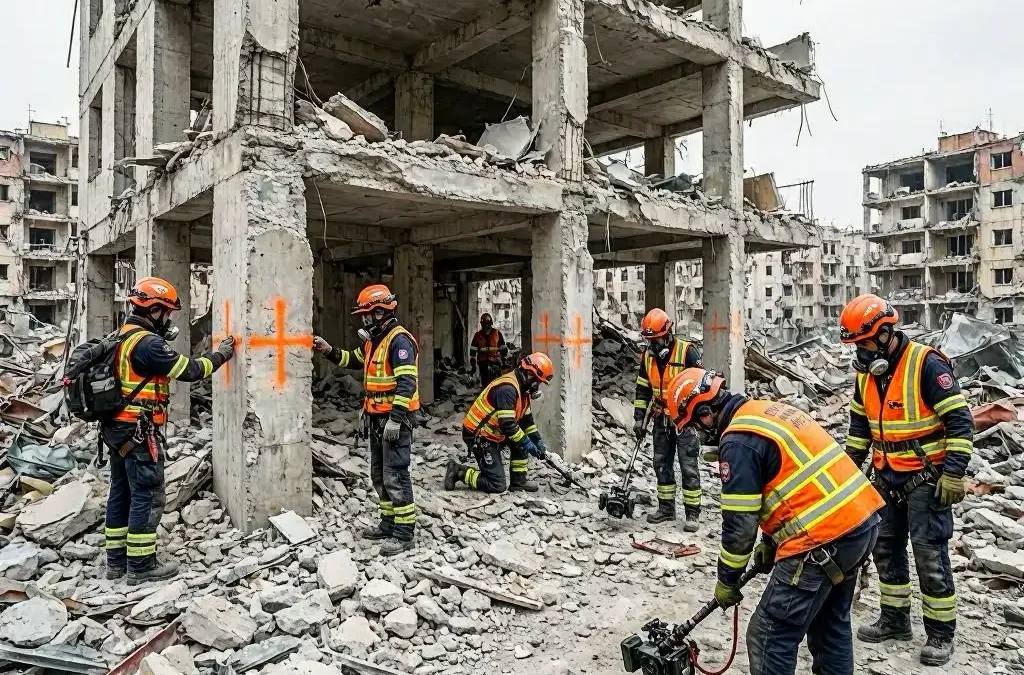
The international community standardizes emergency responses to protect lives during seismic disasters. Specialized search and rescue teams utilize specific structural marking systems to communicate critical hazards in urban environments. Understanding these visual protocols guarantees safety in collapsed structures (safety in collapsed structures) and coordinates international aid effectively.
The INSARAG Marking Matrix: Safety in Collapsed Structures
First responders apply a standardized geometric matrix on the exterior walls of damaged buildings. This symbol, typically a large square or diamond, divides operational data into four distinct quadrants. Each quadrant delivers immediate, vital data regarding structural stability, active hazards, missing persons, and team operations.
The upper quadrant indicates the specific search and rescue team working on the site. The left quadrant details the exact date and time the assessment started. The right quadrant lists the identified hazards, such as active gas leaks, structural weakness, or compromised electrical grids. Finally, the lower quadrant displays the number of victims found, differentiating between survivors and fatalities. Emergency personnel update this matrix continuously as the structural status changes.
Analyzing Critical Risk Glossaries for Safety in Collapsed Structures
Accurate hazard documentation maintains safety in collapsed structures (safety in collapsed structures) by alerting subsequent rescue waves. Teams use internationally recognized codes within the right quadrant to specify environmental threats. For example, the code “G” represents natural gas leaks or hazardous chemical vapors, while “E” indicates live, uninsulated electrical lines.
Rescuers evaluate these hazards before entering any confined space. Uncontrolled gas leaks present an immediate explosion risk, especially when combined with sparking electrical infrastructure. Furthermore, structural shift indicators receive specific annotations to prevent teams from entering zones prone to secondary collapse. This methodical categorization replaces ambiguous terminology with direct, actionable engineering data.
Structural Assessment Protocols and Safety in Collapsed Structures
Field engineers examine load-bearing components to determine the overall stability of the building. They mark compromised columns, sheared beams, and cracked foundations to establish safe entry corridors. This systematic evaluation prevents unnecessary risks and maximizes the efficiency of specialized search cameras and canine units.
Implementing these marking protocols minimizes miscommunication between local authorities and international task forces. When a rescue team reads the external matrix, they instantly comprehend the internal layout and the remaining dangers. Consequently, this universal technical language optimizes resource allocation and saves critical time during the golden hours of disaster response.
References
-
International Search and Rescue Advisory Group (INSARAG). Guidelines and Methodology: Structural Marking and Evaluation Protocols.
-
United Nations Office for the Coordination of Humanitarian Affairs (OCHA). Urban Search and Rescue (USAR) Field Operations Manual.
-
Federal Emergency Management Agency (FEMA). Structural Specialist Field Operations Guide for Sub-surface Stabilization.
Institutional Solidarity Note
UDANA INC stands firmly with the Venezuelan people during these challenging times. Through scientific education and rigorous technical guidance, we aim to empower communities and rescue teams with the knowledge necessary to navigate adversity. Together, with resilience and unified efforts, we will rebuild and safeguard our future.