
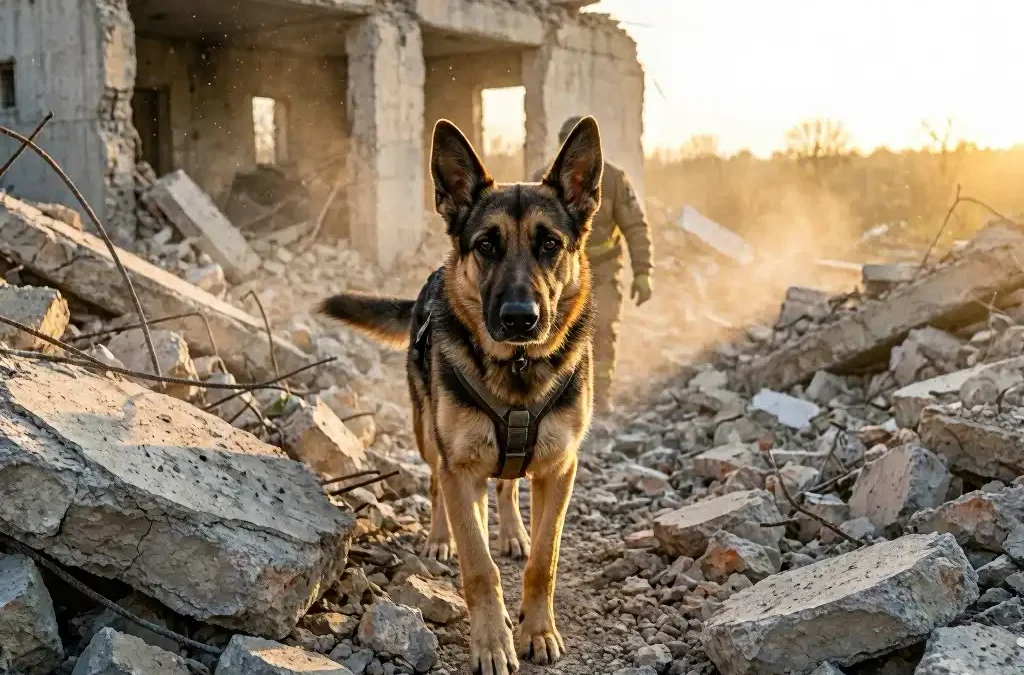
The collapse of structures after seismic events demands an immediate, coordinated technical response with solid scientific bases. In this extreme scenario, the localization of survivors trapped under rubble depends to a great extent on the intervention of specialized duos. The use of search and rescue dogs constitutes the fastest resource for the marking of life points, overcoming the initial limitations of technological acoustic detection equipment. However, the effectiveness of these specimens does not respond to chance, but to a rigorous training based on international regulations and on the physical analysis of the disaster environment.
Criteria of the International Regulations for Search and Rescue Dogs
The International Rescue Dog Organisation (IRO), based in Switzerland, establishes the global standards that regulate the preparation of these response units. These guidelines structure demanding phases of habituation, obedience, physical dexterity, and olfactory focus. Consequently, the accreditation of a duo under this framework guarantees that the canine ignores common distractors in catastrophe zones, such as scattered food, heavy machinery noises, or the presence of other animals. Likewise, periodic evaluations measure the persistence capacity of the animal and the precision of its barking as an unequivocal marking signal, significantly reducing false positives in the area of operations.
Dynamics of Fluids and Air Currents in the Work of Search and Rescue Dogs
The localization of the scent cone requires a deep understanding of local meteorology and thermodynamics by the tactical handler. The odoriferous particles emanated by a buried person travel through the structural voids of the collapse, moving according to differences in pressure and temperature. During the early hours of the morning, the heating of the ground generates ascending currents that elevate the particles, facilitating detection at a greater distance. On the other hand, nighttime cooling produces descending currents that concentrate the scent near the cracks. The handler must position the canine downwind so that the currents transport the molecules directly towards the nasal cavities of the specimen, optimizing the response time.
Neighborhood Behavior to Protect the Work of Search and Rescue Dogs
The conduct of the civilian population in the perimeter of the incident directly influences the performance of the canine teams. The presence of crowds generates a saturation of suspended human olfactory particles, which generates sensory fatigue and confusion in the animal in service. Consequently, the community must evacuate the work area in an orderly manner and strictly respect the security perimeters established by local authorities. Avoiding the handling of personal objects of the potential victims in the vicinity of the collapse also prevents the dispersion of false clues, allowing the duo to maintain its concentration at the epicenter of the search.
References
-
International Rescue Dog Organisation (IRO): Standards for International Rescue Dog Tests (Test regulations for the evaluation and certification of rescue canine duos).
-
International Search and Rescue Advisory Group (INSARAG): INSARAG Guidelines, Volume II: Preparedness and Response (Operational guidelines on the integration of canine resources in urban search operations).
Institutional Solidarity Note
At UDANA INC, we reaffirm our strong commitment to the communities affected by the recent earthquakes across the country. We firmly believe that technical preparedness and community unity are the most powerful tools to overcome adversity and rebuild Venezuela’s future with hope.